Private Sewer Lateral Programs in California
A statewide policy and implementation framework for cities, sanitation districts, and local agencies
Executive Summary
Private sewer lateral (PSL) programs have become a critical—and unavoidable—component of wastewater governance in California. Although private sewer laterals are typically owned and maintained by property owners, failures in these pipes are a documented source of sanitary sewer overflows (SSOs) that affect public rights-of-way, surface waters, and coastal environments. As regulatory scrutiny has increased and infrastructure systems have aged, municipalities across the state have implemented private sewer lateral inspection and compliance programs to reduce environmental risk and demonstrate reasonable systemwide management.
This paper provides a statewide, authoritative overview of private sewer lateral programs in California, written for city councils, public works and utilities staff, city managers, sanitation district leadership, and policy advisors. It explains the technical and policy rationale for PSL programs, examines common program structures and enforcement models, and expands on specific program design considerations that materially affect public outcomes, administrative efficiency, and market fairness, drawing in part from policy recommendations developed for California real estate and municipal stakeholders.
The goal of this document is not to advocate for a single ordinance model, but to clarify the tradeoffs inherent in PSL program design and to highlight policy levers that can significantly improve outcomes for cities, property owners, and the real estate market.
1. The Changing Role of Private Sewer Laterals in California
For much of California’s municipal history, wastewater policy focused almost exclusively on publicly owned infrastructure: sewer mains, pump stations, and treatment facilities. Private sewer laterals were treated as ancillary components—privately owned assets outside the direct scope of municipal responsibility.
This division is no longer sufficient.
Private sewer laterals now represent one of the most common and least predictable sources of SSOs statewide. When these failures occur, wastewater often discharges into streets, storm drains, creeks, or coastal waters. At that point, ownership distinctions offer little practical protection. The city must respond, report, remediate, and answer to regulators and the public.
As a result, private sewer laterals have moved from the periphery of wastewater management to its center. PSL programs are the primary mechanism through which municipalities address this gap.
2. What a Private Sewer Lateral Is—and Why It Matters to Cities
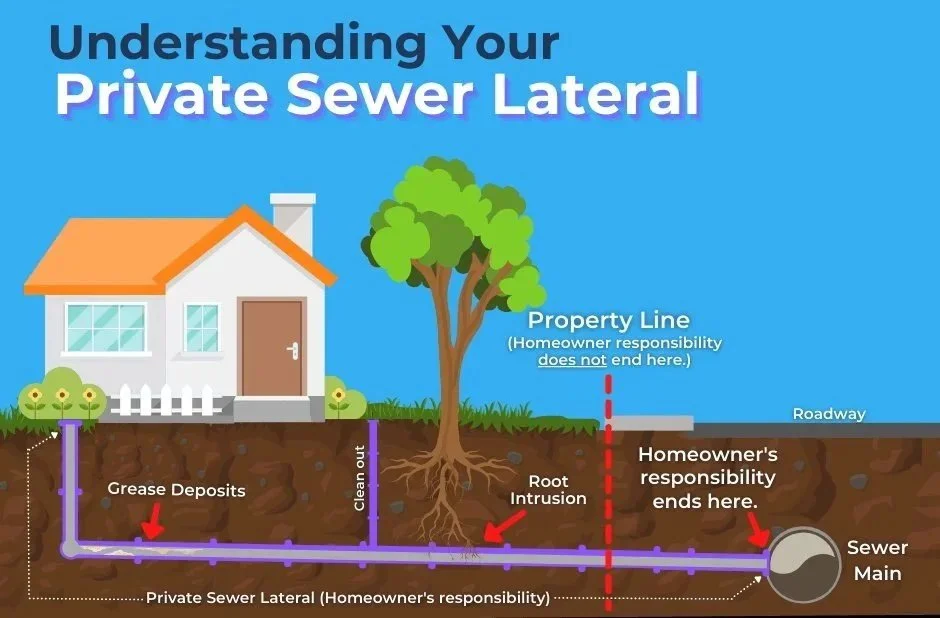
A sewer lateral is the pipeline that conveys wastewater from a building to the public sewer main. Most laterals consist of a segment from the building to the property line, a segment extending to the main, and a physical connection—typically a wye or tap—into the public sewer.
Ownership of these segments is defined by local ordinance and varies across jurisdictions. Many California cities now assign responsibility for the entire lateral, including the portion under the public right-of-way, to the property owner. Other jurisdictions maintain split or hybrid ownership models.
From a municipal perspective, the precise ownership boundary is less important than the operational reality: the lateral is the interface between private development and the public system, and failures at that interface generate public consequences.
3. Ownership, Responsibility, and Regulatory Exposure
While ownership establishes who pays for inspection and repair, it does not determine who bears regulatory exposure. When sewage enters waters of the state, regulators assess whether the municipality has taken reasonable steps to manage known sources of pollution.
Municipal obligations typically include:
Spill response and cleanup
Reporting to state and regional agencies
Public notification where required
Long-term mitigation and compliance planning
Cities that rely solely on ownership distinctions without implementing management strategies for private laterals face elevated risk. This reality underpins the regulatory defensibility of PSL programs, even when laterals remain privately owned.
4. Why Private Sewer Laterals Fail
The failure of private sewer laterals is driven by predictable, cumulative factors.
Aging Materials
Much of California’s housing stock was built using materials such as Orangeburg, cast iron, and vitrified clay. These materials have finite service lives and well-documented failure modes. Orangeburg, in particular, deforms and collapses over time. Cast iron corrodes internally. Clay pipe joints separate and admit roots.
External Stressors
Soil movement, seismic activity, root intrusion, increased hydraulic load from remodels and ADUs, and deferred maintenance all accelerate deterioration. Because laterals are rarely inspected absent a trigger, failure often goes unnoticed until it becomes acute.
From a systemwide perspective, these conditions mean that private lateral failure rates are increasing, not stabilizing.
5. Why Cities Implement PSL Programs
Most municipalities do not adopt PSL programs proactively. They do so in response to external pressures that make inaction untenable.
Sanitary Sewer Overflows
Statewide data consistently shows that a meaningful percentage of SSOs originate from private laterals. Once this contribution is documented, ignoring it undermines spill reduction goals.
Regulatory Expectations
Regional Water Quality Control Boards increasingly expect municipalities to demonstrate comprehensive wastewater system management, including private-side vulnerabilities
Litigation Risk
Environmental NGOs have successfully argued that cities failed to manage foreseeable pollution sources by ignoring private laterals. Several PSL programs were implemented following litigation or as part of settlement agreements.
Protection of Public Investment
Cities investing in public sewer rehabilitation often find that infiltration, inflow, and spills persist unless private laterals are addressed concurrently.
6. Core Structure of Private Sewer Lateral Programs
Despite local variation, most PSL programs follow a common framework:
A defined trigger requires inspection
A CCTV inspection is performed
Results are submitted to the municipality
City staff review the inspection
An outcome is issued (pass, conditional, repair required)
Compliance is tracked and documented
Policy debate typically centers on triggers, review timelines, and enforcement, not on the inspection technology itself.
7. Inspection Triggers: Policy Tradeoffs
Point of Sale
Point-of-sale inspection requirements are the most common trigger statewide. From a municipal standpoint, this approach aligns inspection with property transactions, allowing gradual systemwide assessment without citywide mandates.
Construction and ADUs
Permitting processes provide leverage to ensure lateral capacity and condition are evaluated when wastewater demand increases.
Notices of Violation
When a spill is traced to a specific property, inspection and repair requirements are straightforward and defensible.
Capital Improvement Projects
Some cities require inspections alongside public sewer rehabilitation projects to maximize efficiency and reduce future disruption.
8. Interaction with the Real Estate Market
Point-of-sale PSL programs inevitably intersect with real estate transactions. This intersection is both a strength and a risk. While it leverages existing due diligence processes, it also introduces PSL programs into a time-sensitive and highly visible context.
Programs that lack predictable review timelines or clear documentation often generate public frustration and political pushback. Conversely, programs that integrate smoothly into escrow workflows tend to gain acceptance, even when repairs are required.
9. Review Timelines as a Policy Lever
One of the most consequential—and often overlooked—elements of PSL program design is municipal review time.
Extended or unpredictable review timelines delay escrows, certificates of occupancy, and construction schedules. From a policy perspective, this creates friction that is unrelated to environmental benefit.
Policy recommendations developed for California stakeholders emphasize the value of same-day or next-day review targets, with written justification required for delays beyond that window . Such standards improve transparency, reduce uncertainty, and impose internal discipline without altering inspection criteria.
10. Data Accessibility and Market Fairness
Another critical design consideration is how inspection data and municipal review comments are shared.
When inspection videos, reports, and city review letters are fragmented across emails or paper files, property owners are often functionally locked into the inspecting contractor. This creates what has been described as an “unintentional monopoly”, where the cost of seeking a second opinion is prohibitively high due to data friction.
Requiring municipalities to digitally attach review letters to the original inspection report and video—accessible through a single, shareable link—materially improves market fairness. Property owners can seek additional bids, pricing becomes more competitive, and cities avoid the perception that their programs inflate repair costs.
From a governance standpoint, this policy choice does not weaken enforcement; it strengthens legitimacy.
11. Sewer Lateral Inspections: Purpose and Evaluation
The purpose of a sewer lateral inspection is risk identification, not perfection. City staff typically evaluate inspections for structural integrity, leakage, collapse, high-risk materials, and conditions likely to cause near-term SSOs.
Programs that frame inspections as risk assessments rather than fault-finding exercises are more defensible and easier to administer.
12. Repair Methods and Municipal Oversight
Most PSL programs allow a combination of:
Trenchless lining
Pipe bursting
Open trench replacement
Municipal oversight focuses on ensuring repairs meet adopted standards, protect public infrastructure, and minimize right-of-way impacts. Clear guidance on allowed methods reduces appeals and disputes.
13. Enforcement Mechanisms
Enforcement models vary widely. Some programs rely primarily on disclosure, while others link compliance to utilities, permits, or escrow clearance.
Programs that require inspections but lack meaningful enforcement may reduce environmental benefit while still exposing cities to regulatory scrutiny. Conversely, enforcement that is aggressive but poorly communicated can generate resistance. Alignment with existing municipal processes remains the most durable approach.
Conclusion
Private sewer laterals occupy a complex space between private ownership and public responsibility. While ownership may remain private, the environmental and regulatory consequences of failure are public and increasingly scrutinized.
For California cities, the policy question is no longer whether private sewer laterals should be addressed, but how. Programs that are transparent, administratively efficient, and attentive to market dynamics are best positioned to reduce SSOs, protect water quality, and maintain public trust over the long term.