Why Municipalities Are Moving Private Sewer Lateral Programs Out of Email and Into Infrastructure
Private sewer lateral (PSL) programs sit at one of the most complex intersections in local government: private property, public risk, environmental regulation, and real-estate transactions.
When these programs function well, they quietly reduce sewer spills, improve water quality, and protect the public interest. When they function poorly, they become personality-driven, opaque, administratively burdensome, and difficult to defend.
The difference is rarely policy intent. It is almost always program structure.
Across California, cities and sanitation districts are recognizing that PSL programs cannot be sustainably administered through informal workflows—emails, PDFs, spreadsheets, and ad-hoc decision making—without creating inconsistency, staff burnout, and public frustration. As programs scale, these inefficiencies compound.
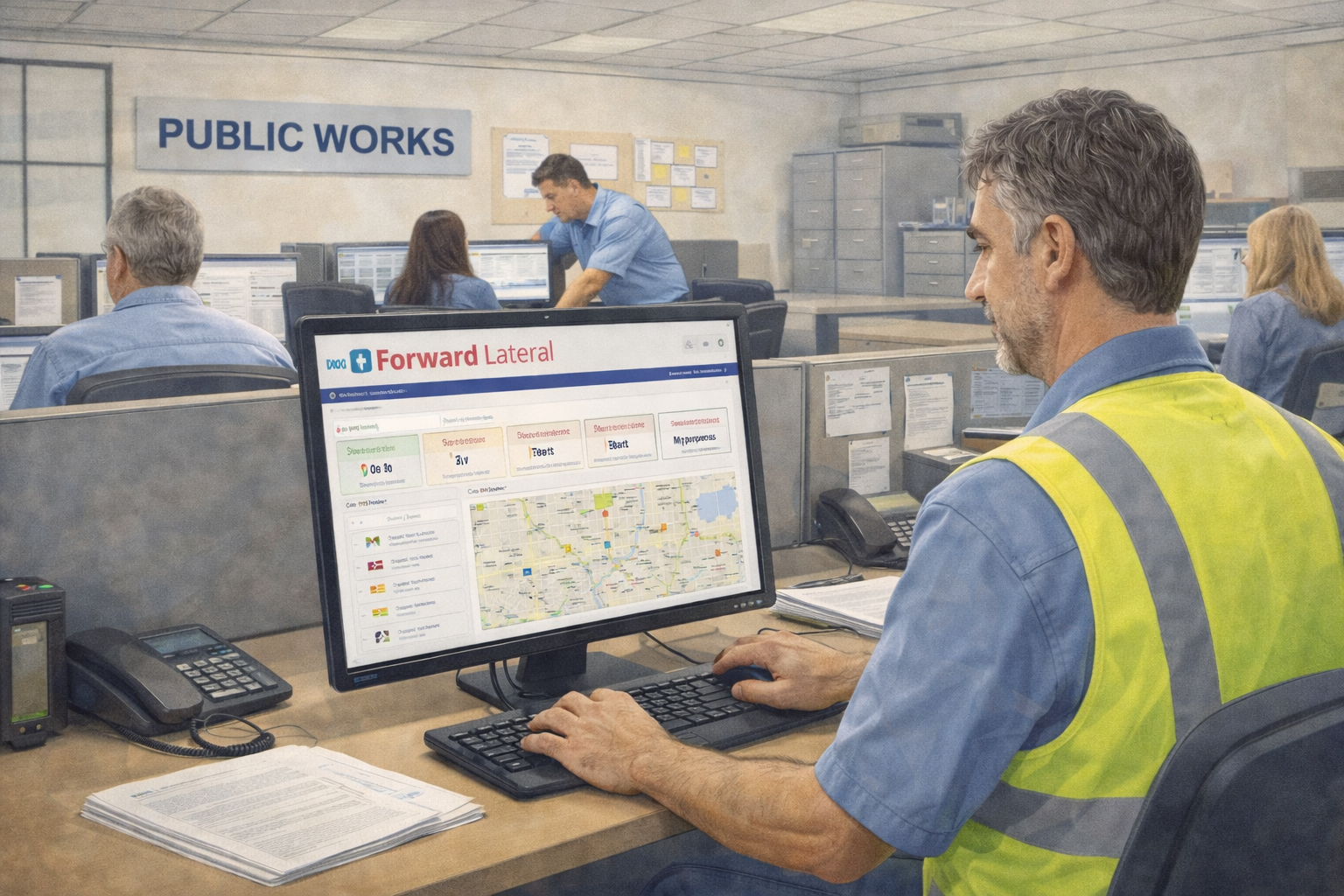
Forward Lateral was built to address that reality by helping municipalities standardize PSL administration, reduce administrative drag, and create continuity across staff, time, and transactions.
Moving Programs Away From Personality-Centric Administration
One of the most common challenges municipalities face is that PSL programs become unintentionally dependent on individual staff members. Institutional knowledge accumulates in inboxes, personal folders, and memory. Review standards evolve informally. Communication tone varies by reviewer. Even when outcomes are technically sound, the process can feel inconsistent to the public.
This is not a staffing issue. It is a systems issue.
Forward Lateral allows municipalities to embed common language, review criteria, and procedures directly into the inspection and review workflow. Plumber submissions follow consistent formats. Review outcomes are structured. Communication to property owners reflects defined standards rather than individual drafting styles.
The result is a program that operates on process, not personality—an essential condition for regulatory defensibility and public trust.
One System, One Source of Truth
Legacy PSL workflows tend to fragment information:
CCTV videos arrive via email or file-sharing links
Inspection reports come as PDFs or scanned forms
Review notes live in individual inboxes
Status tracking happens in spreadsheets
Forward Lateral consolidates this into one centralized system where:
Plumber-submitted inspections are linked directly to city reviews
Videos, reports, maps, and determinations live together
Status is visible in real time
Historical records remain accessible
This eliminates parallel versions of the same information and ensures that staff, property owners, and other stakeholders are referencing the same materials.
Standardized Inputs Reduce Review Time and Rework
A significant portion of staff time in PSL programs is spent not on substantive review, but on resolving incomplete or inconsistent submissions. Missing data, unclear terminology, and incompatible formats create delays that benefit no one.
Forward Lateral is designed to guide plumbers toward complete, review-ready submissions by structuring data entry around what municipalities actually need to evaluate. Required fields, standardized observations, and consistent organization reduce clarification requests and resubmittals.
This improves efficiency without lowering standards. Reviewers spend less time correcting inputs and more time evaluating conditions.
Built-In File Safety and Risk Reduction
Municipalities increasingly carry responsibility for safe data handling. CCTV videos and inspection files delivered through email attachments or third-party links present cybersecurity risks that are difficult to manage consistently.
Forward Lateral automatically virus-scrubs incoming CCTV files and stores them in a controlled environment designed specifically for inspection media. This removes reliance on individual staff judgment to determine whether files are safe to open or where they should be stored.
This is not simply an IT improvement. It is a risk-management measure that protects staff and municipal systems.
Transparency That Improves Compliance and Public Trust
PSL programs can feel opaque to property owners, particularly when outcomes affect escrow timelines or require costly repairs. When documentation is fragmented, it becomes difficult for the public to understand what was reviewed, what failed, and why.
Forward Lateral allows municipalities to provide property owners with clear, consolidated access to:
The inspection video
The inspection report
The city’s determination
Clearly stated next steps
Transparency does not weaken enforcement. It strengthens legitimacy. When decisions are traceable and well-documented, disputes decrease and compliance improves.
Data-Rich Dashboards for Program Oversight
Beyond individual inspections, municipalities need visibility into program performance.
Forward Lateral provides dashboards that allow staff and leadership to evaluate:
Inspection volumes
Review timelines
Common failure conditions
Repair outcomes
Geographic patterns
With ArcGIS integration, these insights can be spatially contextualized—connecting private lateral conditions with public sewer mains, CIP projects, or environmentally sensitive areas. This elevates PSL data from a compliance requirement to an operational planning resource.
Integrating Private Laterals With Mainline Context
PSL programs do not operate in isolation from the public sewer system. Forward Lateral supports workflows that include:
Lateral launch inspections
Mainline inspections that document wye connections
Capturing lateral condition context during CIP work
This allows municipalities to connect private-side data with public infrastructure conditions, improving long-term planning and communication with property owners.
Institutional Memory That Persists Through Turnover
Staff turnover and vacations are unavoidable. In personality-centric systems, they are disruptive. Backlogs grow, standards drift, and continuity suffers.
Forward Lateral preserves institutional memory. Review history, determinations, correspondence, and documentation remain visible regardless of who is on leave or who has moved on. New staff can understand what decisions were made and why.
This continuity supports efficiency, morale, and defensibility.
Reducing Burnout by Removing Repetitive Administrative Work
PSL administration involves a high volume of repetitive tasks: tracking submissions, sending confirmations, answering status questions, re-sending documents, and reconciling records.
Forward Lateral automates much of this work:
Submission confirmations are automatic
Notifications go to all relevant parties
Status is visible without inquiry
This allows staff to focus on higher-value activities—public communication, complex case review, and program improvement—rather than routine clerical tasks that contribute to burnout.
Consistent Drafting Support Through Sewer Pirate AI
After a review technician selects the outcome of an inspection—pass, conditional acceptance, or repair required—Forward Lateral’s Sewer Pirate AI assists by generating a clear draft summary and proposed next steps based on those selections.
Importantly, this draft is not automatic enforcement. It is a starting point.
Staff can:
Review the language
Edit for nuance or jurisdiction-specific detail
Ensure accuracy and clarity
The value lies in consistency. Over time, similar inspection outcomes are described using similar language, tone, and structure. This reduces drafting time, improves clarity for property owners, and ensures that communications reflect program standards rather than individual writing styles.
Sewer Pirate AI supports efficiency and consistency while keeping judgment firmly in the hands of municipal staff.
The Bottom Line for Municipalities
Private sewer lateral programs are growing in importance as infrastructure ages and regulatory expectations increase. The question for municipalities is not whether to manage them, but how.
Forward Lateral helps cities move PSL programs:
From fragmented workflows to centralized systems
From personality-driven decisions to standardized processes
From opaque communication to transparent documentation
From staff-intensive administration to sustainable operations
Not by replacing policy or judgment, but by supporting them with structure.
For municipalities, that means fewer spills, clearer records, healthier workflows, and more time spent on meaningful public service rather than repetitive administrative work.